

Indoor vs Outdoor Cats Statistics & Trends
Looking at the latest indoor vs outdoor cat statistics, we can see clear trends towards why purr-ents decide to keep their furry babies indoors only. The numbers show the many differences in health risks, mortality, and overall lifespan.
Where a cat lives can affect their health, safety, and exposure to risks on a daily basis. But just how big are those differences in real life?
Let’s check the numbers and find out.
8 Key Indoor vs Outdoor Cats Statistics
- 80.6% of cats are indoor-only in USA/Canada, while only 30.2% in Europe
- 51.8% of households in Australia have unrestricted indoor-outdoor movement
- 53.2% of cats globally are exclusively indoor-only cats
- 60% of cat trauma-related deaths in the UK were caused by road traffic accidents
- Outdoor access cats are 2.77 times more likely to be infected with parasites vs indoor-only cats
- Indoor-only cats’ Quality of Living Score is 72.1
- Median age of death in indoor-only cats is 9.43 years vs 7.25 years for outdoor-only cats
- Ranging domestic cats kill 1.3 to 4 billion birds each year
Do Cats Prefer Indoors or Outdoors?
Cats do not have a universal preference for indoor or outdoor living, rather their personality, previous socialization, and experience all influence how they respond to each lifestyle.
Indoor living reduces exposure to fights, parasites, diseases, traffic, possible poisoning, and various other outdoor hazards. That said, indoor cats still need enough playtime activities, lots of exercise and exploration, and a rich environment that would support their natural behaviors.
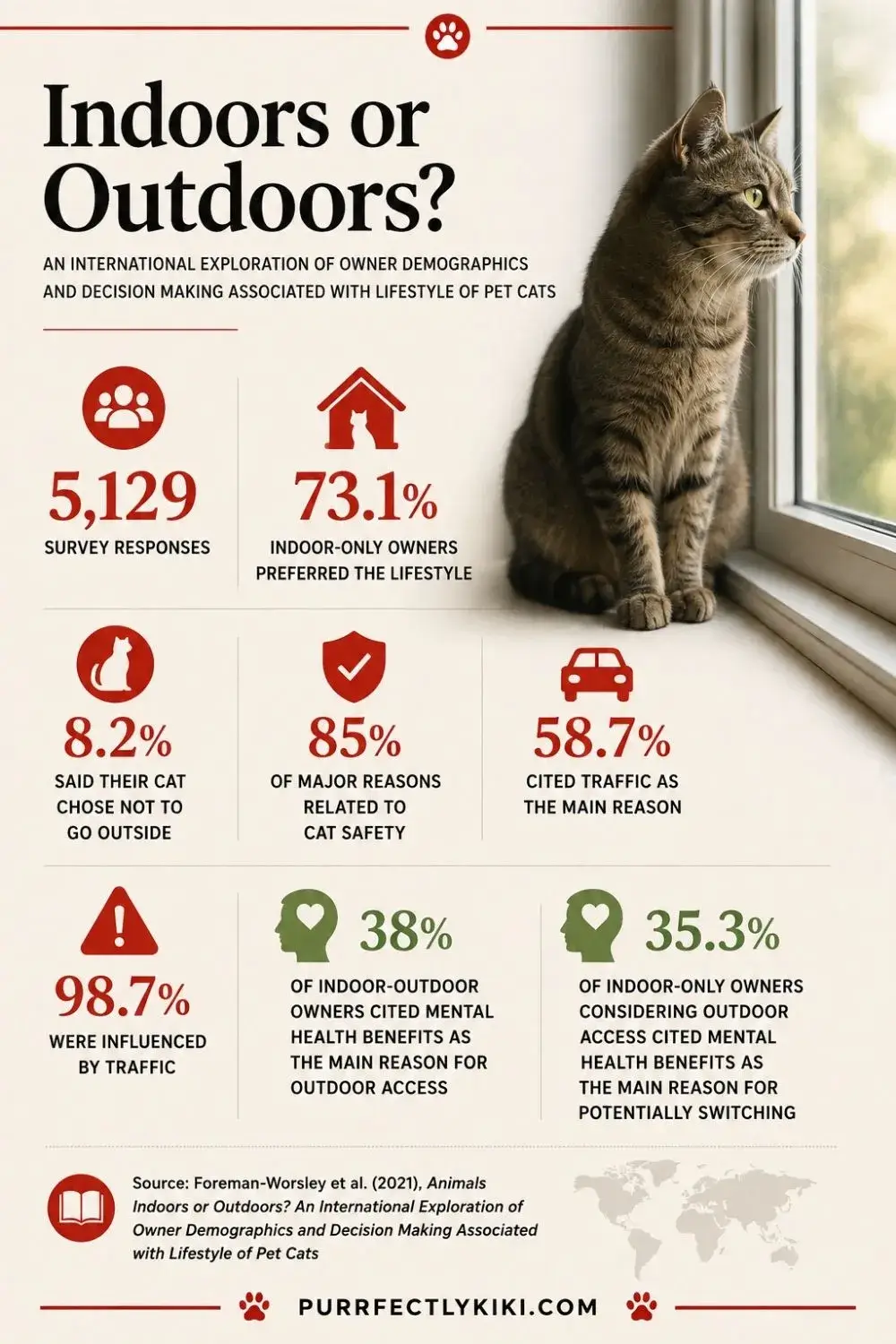
An international study of 5,129 cat purr-ents found that 73.1% of indoor only purr-ents prefer to keep their cas inside only, while only 8.2% said that their furry babies choose not to go outside even when that opportunity is given to them.
We do so as well, as me and my wife keep both Kiki and Lily indoors-only, mostly due to us living in an apartment. That said, even if we resided in a house, we would limit their outdoor access.
Are Indoor Cats Healthier Than Outdoor Cats?
Yes, indoor cats are significantly healthier than outdoor cats. Additionally, they live longer due to protection from trauma, parasites, various diseases, and most commonly, traffic.
Safety is among the biggest factors, with a good reason too, as 85% state protection as the key aspect in their choice for an indoor-only lifestyle.
- 73.1% of purr-ents prefer indoor-only lifestyle for their cats
- 80.6% of cats are indoor only in the USA and Canada
- 30.2% of cats are indoor only in Europe
- 53.2% of 8,224 cats internationally are exclusively indoors
- 72.1 vs 70.3 QOL score for indoor-only vs outdoor cats
- 73.5 vs 67.8 QOL score for cats given 7+ vs 0 to 1 types of games
Moreover, according to these indoor vs outdoor cat lifespan risks statistics, about 58.7% of indoor-only purr-ents say that traffic is the biggest concern and the main reason for keeping cats indoors. What’s more interesting is that a whopping 98.7% state that traffic has influenced their decision to some degree.
This is a very valid way of thinking seeing how dangerous it is nowadays, especially the way people drive their cars. We have been on the receiving end of some devastating news in the past when we lived in houses and left our furry babies to roam free on the outside.
On the other end, indoor-outdoor purr-ents in the same study say there are a lot of mental health benefits of providing outdoor access to their cats. 38% of surveyed purr-ents say this is the main reason why they allow their cats to roam outside.
Source: MDPI
Appeal of the Outdoors – Are Outdoor Cats Happier?
We don’t generally believe that outdoor cats are happier even though outdoor environments provide cats with sounds, smells, movements, climbing opportunities, and potential prey to pounce on. This encourages exploration and satisfies their natural hunting behaviors.
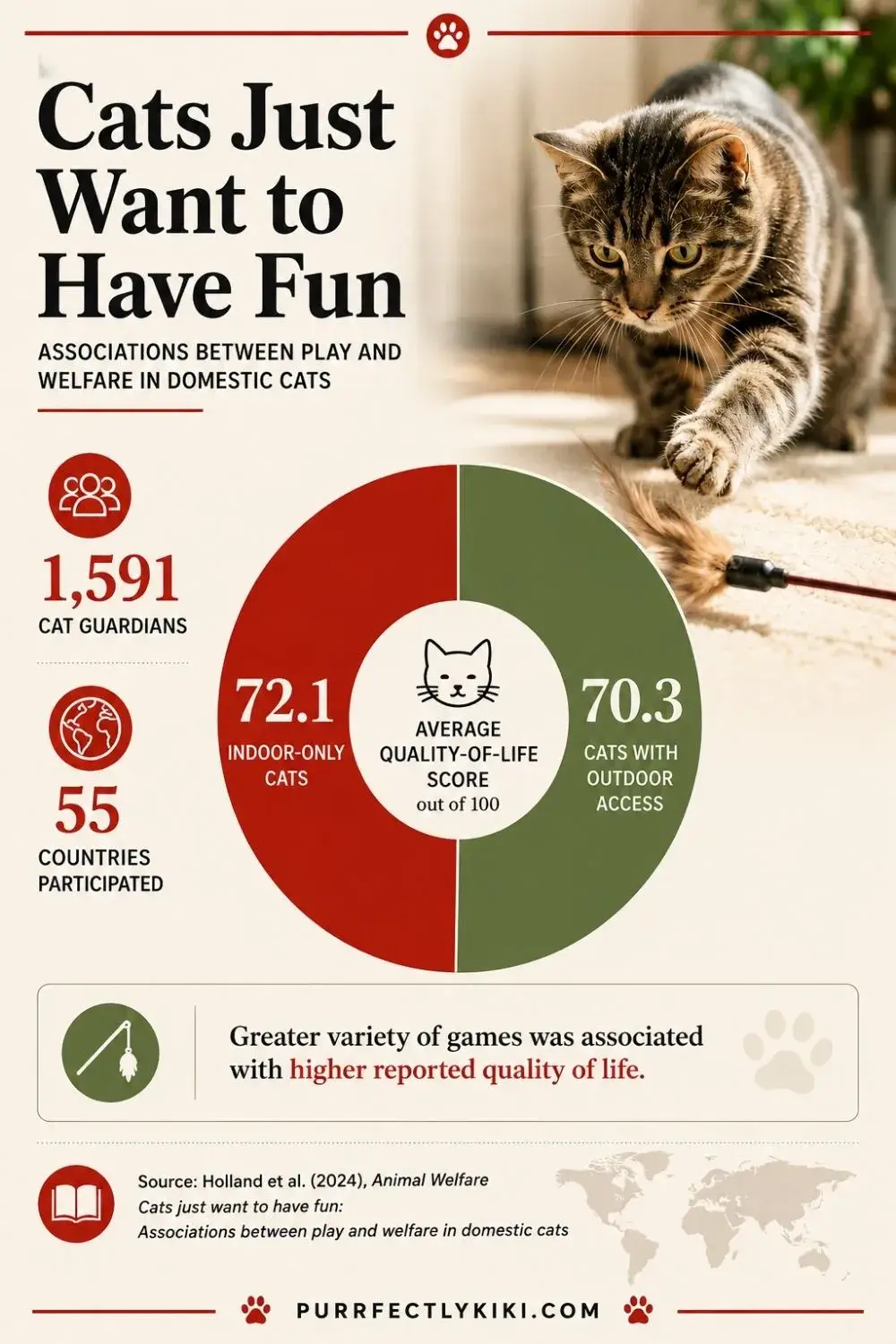
However, a study of 1,591 cat purr-ents from 55 countries have found that indoor cats had a higher average quality of life score compared to cats with outdoor access. The ratio stands at 72.1% compared to 70.3% with the study also claiming that cats who had more types of games tended to have higher quality of life scores.
This would suggest that enriching the environment may matter more than giving outdoor access to your furry baby. An indoor cat that has plenty of opportunities to climb, play, explore, and hunt can have better overall well-being than an outdoor cat that is exposed to significant risks.
Source: PubMed Central
Indoor vs Outdoor Cat Statistics Around the World
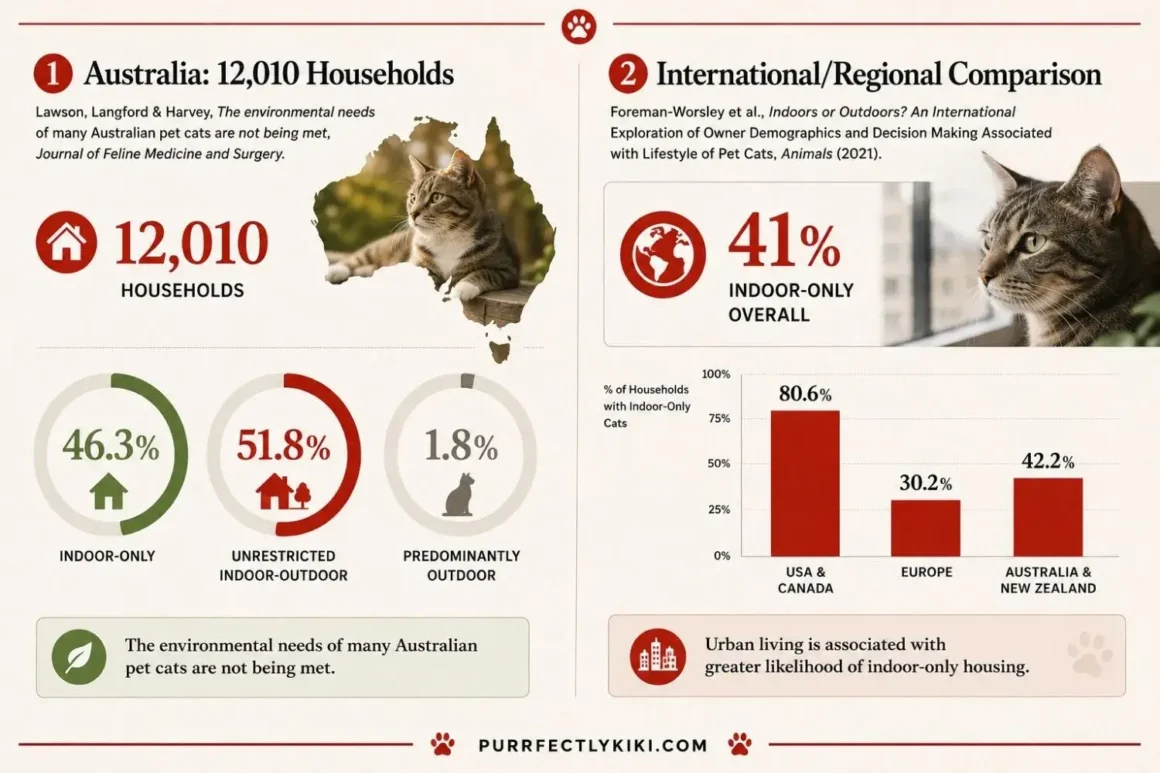
Cat housing patterns vary significantly across the globe. In Australia, 46.3% of cat households were indoor-cats only, while 51.8% had cats with unrestricted access to the outdoors. Of the 12,010 surveyed cat households, only 1.8% reported that they had cats who were predominantly outdoors.
On an international scale, a study covering multiple countries, found that 41% of cats were kept indoors only. This figure rises to 80.6% in the USA and Canada, compared to only 30.2% in Europe and 42.2% in Australia and New Zealand.
In these cases, urban living was also associated with a higher likelihood of keeping cats indoors only. These indoor vs outdoor cat lifespan statistics show us that indoor and outdoor cat care is influenced by culture, living environment, and geography.
Sources: PubMed Central, MDPI
Indoor vs Outdoor Cat Average Lifespan Statistics
Lifestyle influences a cat’s longevity with the strongest evidence suggesting that cats that live outside exclusively have shorter lifespans than cats that are live indoors or with mixed access.
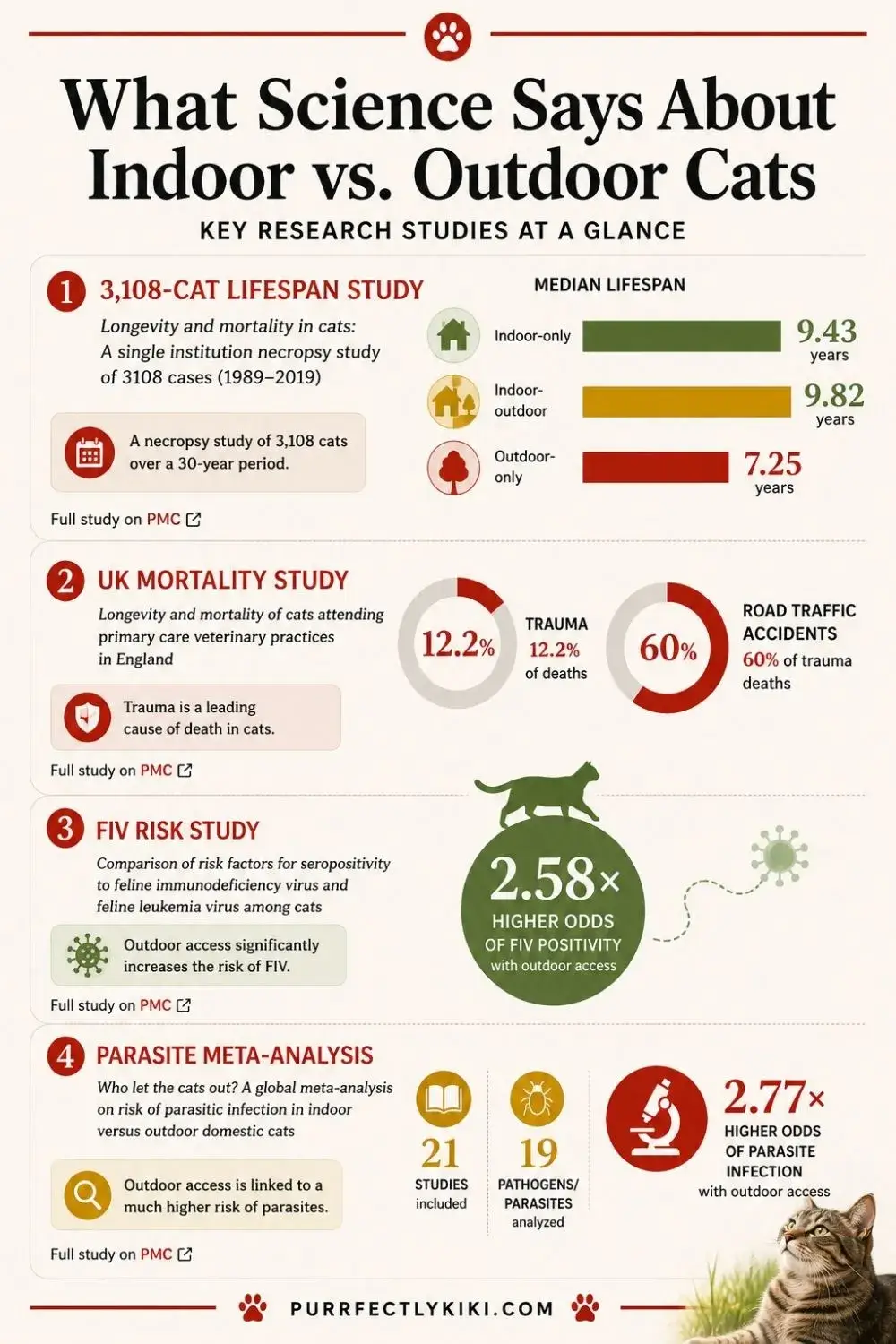
The difference in indoor vs outdoor cat lifespan, though, is not a simple “indoor cats live twice as long”. A necropsy study of 3,108 cats found that the median age of death in indoor-only cats was 9.43 years, compared to 7.25 years for outdoor-only cats.
Cats with a mixed indoor/outdoor access had a median age of death of about 9.82 years.
Source: PMC – Longevity & Mortality in Cats Study
Why Outdoor Cats Face Greater Risks
The risks associated with outdoor access explains this gap, but what exactly do cats face when they are outside and how long do outdoor cats live?
The average lifespan is 2 to 5 years, and these are the most common risks they face with outdoor-living only:
1. Traffic and trauma
Road accidents are a major cause of premature death in cats. In a large UK veterinary study, trauma accounted for 12.2% of deaths, and 60% of trauma-related deaths were attributed to road traffic accidents.
Source: PMC – Longevity & Mortality in Cats
2. Infectious disease
Outdoor access increases exposure to diseases transmitted through contact with other cats and wildlife. For example, cats with outdoor access had 2.58 times the odds of FIV positivity compared with cats without outdoor access in one study.
Source: PMC – Comparison of Risk Factors
3. Parasites
A global indoor vs outdoor cat life expectancy analysis covering 21 studies and 19 parasites found that cats with outdoor access were 2.77 times more likely to be infected with parasites than indoor-only cats.
Source: PMC – Global Meta Analysis
4. Fights and injuries
Outdoor cats have more opportunities for territorial fights, bites, and other injuries, particularly when interacting with unfamiliar cats and wildlife. These encounters can also increase exposure to infectious diseases such as FIV and FeLV.
Source: PMC – Comparison of Risk Factors
5. Poisoning and predation
Outdoor cats can also encounter toxic substances, predators, and other environmental hazards that are largely avoidable indoors. The life expectancy of indoor vs outdoor cats is evident with and without these potential hazards, ranging from 2 to 5 years for outdoor cats, while indoor cats enjoy about 10 to 15 years of life (and oftentimes up to 20).
Source: PMC – Uncontrolled Outdoor Access for Cats Study
These risks accumulate over time as we have seen numerous such cases. Me and my wife have been taking home and caring for cats our entire lives, and have endured heavy losses, most commonly due to fast drivers and malicious people who poison cats for their own various reasons.
🐾 Indoor living does not guarantee a long life, but at least it reduces the exposure to outdoor hazards and can improve a cat’s chances of reaching old age.
Indoor vs Outdoor Cat Life Expectancy Statistics
Even though life expectancy is one of the main differences between indoor and outdoor cats, there are other factors into play as well.
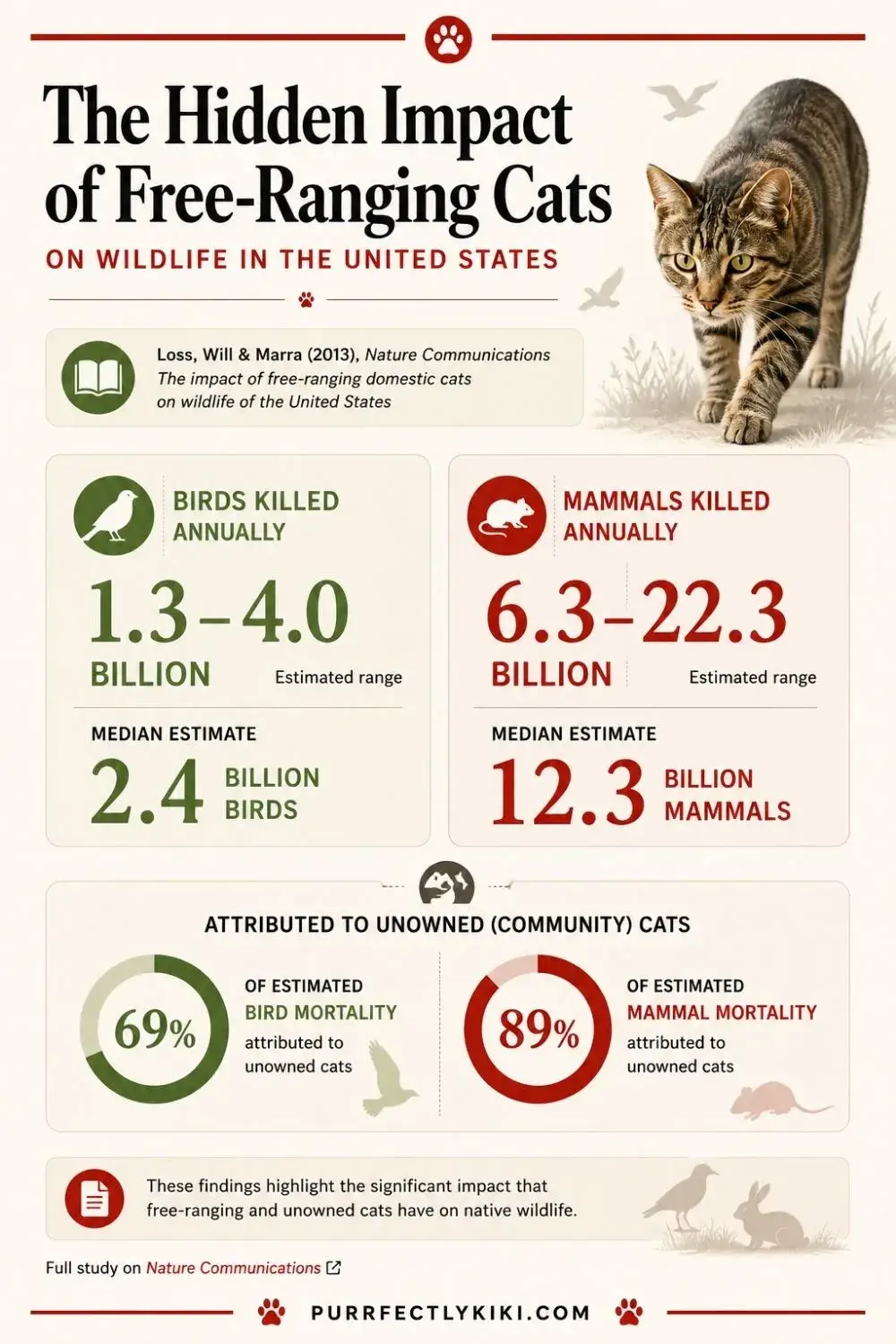
A major US study estimated that free ranging domestic cats kill about 1.3 to 4 billion birds and about 6.3 to a whopping 22.3 billion mammals each year. Most of this mortality was attributed to unowned cats rather than owned cats.
Cats roam about 130 to 650 feet (40 to 200 meters) away from home. For cat purr-ents, this adds another consideration to the decision, as keeping a cat inside can reduce the risks to the cat, while also limiting its impact on wildlife.
However, indoor living works best only when the environment provides enough stimulation for a cat’s natural behavior. Most people fail to understand that cats need to be active and engaged throughout the day, not just a few times a week or month.
With that in mind, indoor cats need regular playtime activities and various opportunities to hide, scratch, play, explore, hunt, and climb. Various cat toys and accessories can provide these outlets without exposing your furry baby to the risks associated with free roaming.
🐾 The ultimate goal is to create an indoor environment that is safe, stimulating, and suited to your cat’s natural behaviors.
Sources: Nature Communications, Nature
Takeaway – What Do the Statistics Tell Us?
Outdoor access can provide freedom and stimulation, but also increases risks that can affect your furry baby’s health and longevity. A safe and rich indoor environment can offer the best balance between natural behavior, longevity, safety, and overall well-being.
That said, the latest indoor vs outdoor cat statistics point towards one clear direction – indoor living is safer for cats as it reduces exposure to traffic, parasites, diseases, injuries, and other outdoor hazards.
